Woodkid’s S16 Proves Spectacle Works Only When the Song Comes First
Seven years after The Golden Age, Woodkid’s S16 turns scale into a creative test: does grandeur deepen the music, or simply repeat his visual signature?
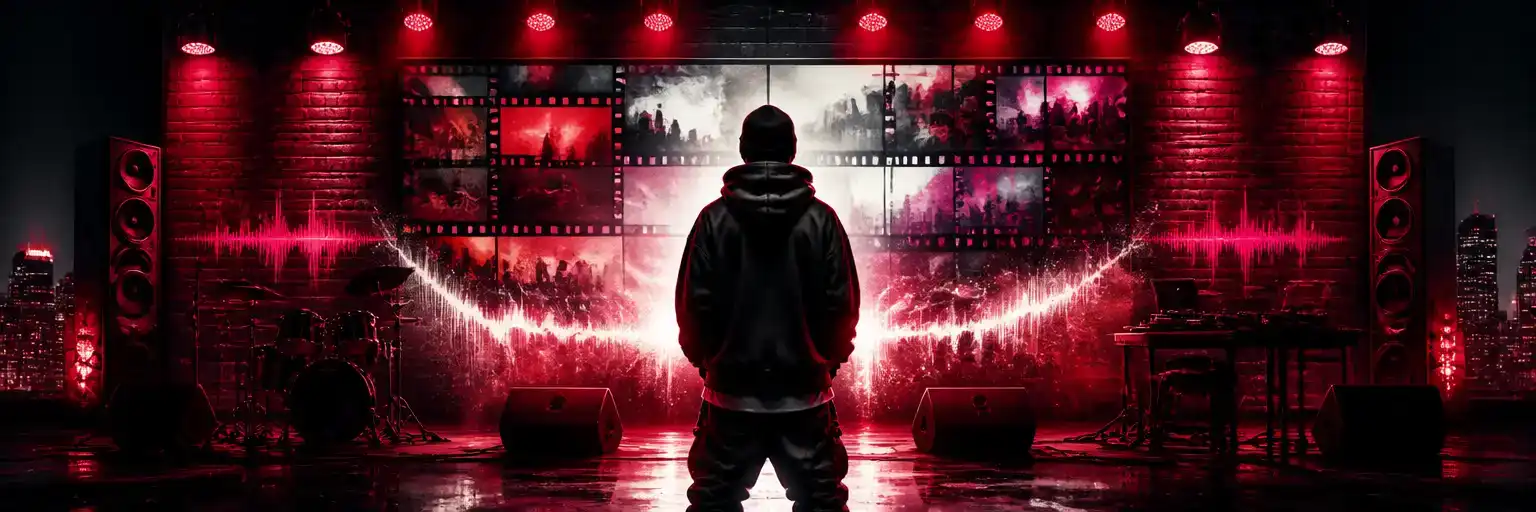
AI-generated image
A grand return is easy to announce and difficult to justify. Seven years after The Golden Age, Woodkid came back with S16, an album surrounded by industrial imagery, orchestral weight and the kind of visual world that has always been inseparable from his music. The real question, however, is not whether the comeback looks impressive. It is whether all that scale still has something new to say.
The answer is more interesting than a simple victory lap. S16 does not abandon Woodkid’s established language; it intensifies it, then occasionally strips it back. That makes the album less a clean reinvention than a stress test. The cinematic ambition remains, but the record is strongest when grandeur becomes a way to expose vulnerability rather than conceal it.
S16 is a development of the formula, not an escape from it
Woodkid’s musical identity has always depended on the collision of the intimate and the monumental. The Golden Age established that tension, while S16 places it inside a darker industrial framework. The album’s title refers to sulfur, the sixteenth element, and the project’s concept turns on oppositions: life and destruction, the human and the machine, the infinitely large and the infinitely small. Its production was recorded at Abbey Road Studios and in Berlin, Paris, Los Angeles and Iceland, with the Suginami Junior Chorus also involved in one passage, according to the album’s release information from Nasty Little Man.
That geography and symbolism matter less as trivia than as evidence of the album’s operating system. Woodkid is not merely decorating songs with atmosphere; he is building a world in which sound, image and theme are supposed to reinforce one another. But this approach carries a danger. Once an artist has found a recognizable visual grammar, repeating its most successful gestures can look like evolution from a distance while feeling like self-quotation up close.
In our view, S16 gets past that problem not by becoming smaller across the board, but by making its scale unstable. The orchestration can feel oppressive, then suddenly give way to piano or exposed vocals. The machinery is not only a backdrop; it becomes a pressure that the songs must resist.
The best songs make spectacle serve emotional risk
“Goliath” is an obvious statement of intent: heavy industrial percussion, a large vocal performance and a conflict between individual fragility and overwhelming forces. Woodkid described the song as a love song that also addresses dominance, ecological crisis and political fear, as documented in a review that reproduces his comments. That combination could easily collapse into grandiose messaging. Instead, the track works because the personal and the public are allowed to remain entangled rather than neatly explained.
“Pale Yellow” is more revealing still. Its subject is addiction to antidepressants, and its movement from orchestral unease to industrial beats gives the song a physical sense of compulsion. The machinery here does not make the emotion more important; it makes the struggle harder to escape. That is the distinction separating meaningful spectacle from expensive decoration.
Other tracks take a more vulnerable route. A review by Noizze highlights “Horizons into Battlegrounds” as a piano-led moment with relatively little additional instrumentation, while also noting the contrast between the album’s orchestral passages and its more direct pop structures. That restraint is crucial. It proves Woodkid’s voice does not need a wall of sound to command attention, and it gives the larger arrangements something to push against.
The visual universe is an asset—and a creative trap
Woodkid’s background as a music video director and graphic designer has always made his work unusually coherent. The songs do not arrive alone; they arrive with architecture, choreography and a sense of scale. That is part of the appeal, but it also creates an unusual burden. When the aesthetic becomes this identifiable, listeners may begin to experience the brand before they experience the composition.
That is why S16 should not be judged by how well it recreates the emotional effect of “Run Boy Run” or the monumental identity of The Golden Age. The relevant standard is whether the visuals open new space around the songs. When the album explores mental health, heartbreak, dependence and collective responsibility, the cinematic treatment can deepen the subject. When the arrangement simply swells because a Woodkid song is expected to swell, the effect is less persuasive.
The record’s industrial inspiration is therefore most successful when it behaves like a dramatic force rather than a costume. Sulfur, machinery and collapsing systems are not just visual motifs; they become metaphors for bodies, relationships and societies under pressure. That gives the album an argument beneath its surfaces.
Seven years later, patience is not the same as progress
The gap between albums inevitably raises expectations. The Golden Age sold nearly one million copies worldwide and received two GRAMMY nominations, according to the album’s release materials. Those figures explain why S16 was treated as an event, but they should not determine its artistic verdict. A long wait does not automatically produce transformation, and a comeback does not need to reject the past to deserve attention.
What S16 offers is more nuanced: a refinement of Woodkid’s central contradiction. He still wants music to feel enormous, but he is increasingly interested in what enormous forces do to a single person. The album’s ambition is therefore not its flaw. The flaw would be ambition without exposure, spectacle without consequence.
Woodkid passes that test often enough to make S16 worthwhile, particularly when the orchestration gives way to voice, piano or emotional uncertainty. It is not a clean break from The Golden Age, and it should not be sold as one. It is a darker, more self-conscious extension of the same project—one that works best when the song remains visible beneath the machinery.
The verdict is clear: listen for the quieter fault lines, not just the monumental peaks. S16 earns its scale when it makes vulnerability sound enormous; it loses its grip when grandeur becomes the destination instead of the means.
No topics yet: start the first one.
More stories
Cesária Évora’s Unreleased Songs Need Care, Not Just a Sales Pitch
Reina da Morna is a rare archive release that feels valuable when it preserves Évora’s unfinished edges—not when it treats absence as a permanent marketing strategy.

A$AP Rocky’s Disc 2 could turn style into cinematic substance
With Disc 2 extending Don’t Be Dumb and a Spike Lee–Malcolm X-inspired next chapter ahead, Rocky is positioning image as part of the argument.
Laura Niquay's 'Nir Wactenama' Challenges Music's Boundaries
With a new album bearing blues influences and a powerful live show blending blues and rock, Laura Niquay continues to amplify Indigenous voices and redefine contemporary music.

Tokio Hotel's 'Encore': A Pop-Punk Return, or Just Recapturing Youth?
With *Encore*, Tokio Hotel's seventh album sees them return to their pop-punk roots. We analyze whether this signals a strategic reconnection with their past or a surprising pivot after years of genre evolution.