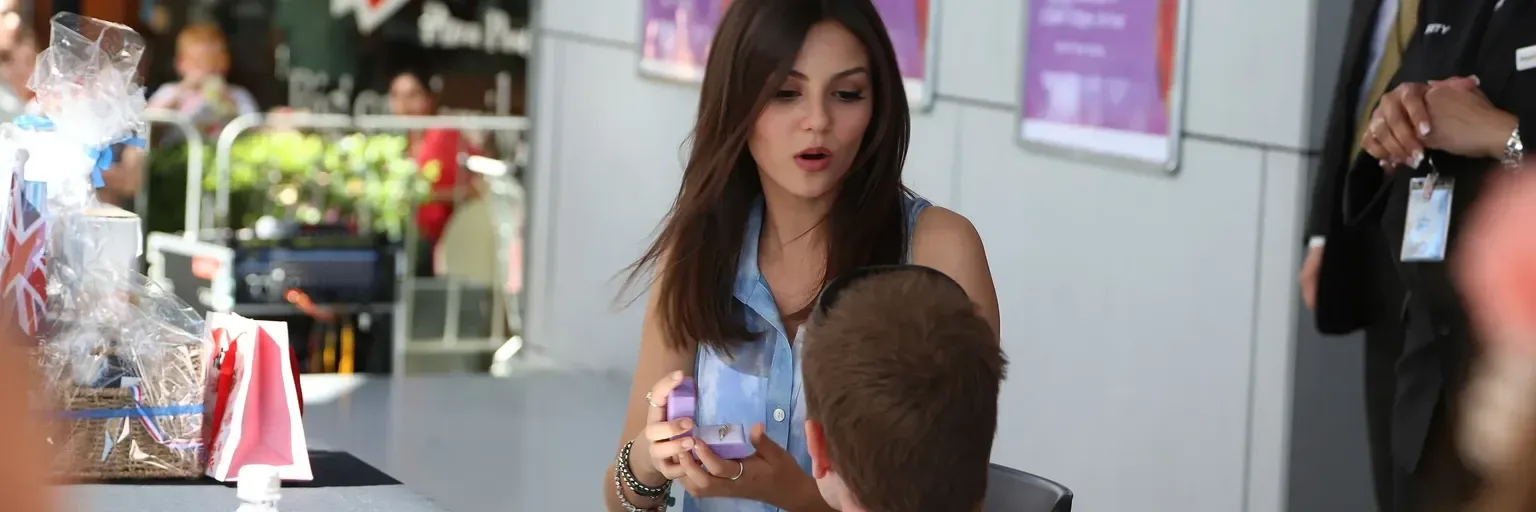
Lady Gaga’s Next Album Needs More Than a Perfect Popstar Moment
A new hint has revived anticipation, but Gaga’s next era will matter only if it risks disrupting the polished celebrity machine around her.
Photo: cesareb / Wikimedia Commons (CC BY 2.0)
A two-word reply has done what an elaborate campaign often cannot: made Lady Gaga’s next album feel imminent. But “don’t worry” is not an announcement, and the real question is not whether Gaga can make the internet pay attention. Of course she can. The question is whether her next release can make that attention feel necessary.
On October 19, Gaga responded to a fan asking her not to make listeners wait too long for new albums with “don’t worry” and two heart emojis, as Billboard reports. No release date or project was confirmed, and a spokesperson had not provided further details. Still, the timing has turned a casual social-media exchange into a useful test of where Gaga stands after Mayhem and its enormous campaign around it.
The next era cannot survive on anticipation alone
Gaga has already demonstrated that she can make a return feel like an event. Mayhem, released in 2025, was framed as a return to her pop roots while also promising a fresh, “furchtlose” artistic perspective, according to the album’s promotional language reported by Musikexpress. The project had 14 tracks, and its rollout included “Disease,” “Abracadabra” and “The Dead Dance.”
That is an impressive apparatus, but it also reveals the trap facing the next album. Gaga’s celebrity is now so powerful that almost any musical move can be packaged as a cultural occasion. A single can become a costume moment, a performance can become a headline, and a hint can become a news cycle. The danger is that the event begins to substitute for the work.
We think Gaga’s next era needs to resist that substitution. It does not need to be obscure, commercially hostile or deliberately chaotic. It does need to make a choice that feels artistically consequential rather than merely well timed. “Bigger” is not the same as “bolder.”
Mayhem raised the standard by reconnecting Gaga with risk
The significance of a follow-up is not that Gaga has to recreate her earliest shock tactics. That would be nostalgia disguised as rebellion. Her challenge is more interesting: to reconcile the unpredictable pop auteur with the dependable global celebrity without allowing one to flatten the other.
The first version of Gaga built identity through provocation, theatrical excess and sudden changes of direction. The second version can headline a global operation with extraordinary precision. Billboard says the Mayhem Ball tour crossed five continents, grossed nearly $420 million and ranked among the 10 highest-grossing tours by a woman in Billboard Boxscore history. That scale is evidence of power, but it also creates pressure. Once an artist has proved she can operate at that level, spectacle becomes the expected baseline.
The next album therefore needs a creative center strong enough to survive the machinery around it. A carefully engineered prestige event could be successful and still feel disappointing. Gaga has already earned the right to make a less predictable record; the question is whether the industry around her will let unpredictability remain visible long enough to matter.
The timing makes the music more important, not less
The hint arrives after the end of the Mayhem Ball tour in April and after Gaga welcomed her first child in June, according to Billboard. That context makes the vagueness understandable. It also makes it tempting for audiences to project an entire narrative onto two words and a pair of emojis.
That projection is exactly what Gaga must avoid relying on. Fans are not merely waiting for songs; they are waiting to learn what this stage of her life and career sounds like. Yet the answer should come from the music, not from speculation about her private circumstances. A new album should not be treated as a biographical receipt or a celebrity update. It should be judged as an artistic argument.
This is where Gaga’s global celebrity status becomes both advantage and liability. She can command attention before releasing a note, but attention is the least difficult part of her job now. The harder task is giving listeners a reason to return after the headlines have moved on.
A smaller promise could produce a stronger album
The smartest move would be to make the next era feel specific rather than universally monumental. Gaga does not need to announce a transformation every time she changes direction. She needs a sonic and visual world with enough internal tension to make the album more than a collection of high-value moments.
That could mean choosing a less obvious collaborator, leaning into an unfamiliar structure or allowing a song to remain strange instead of sanding it down for maximum reach. Those are possibilities, not reported plans. What matters is the principle: risk must exist in the finished record, not only in the marketing language surrounding it.
The temptation will be to treat the next album as a coronation. After Mayhem and a tour of that scale, the business case for doing so is obvious. But coronations are built to confirm power, while great pop eras often begin by making power unstable again.
Gaga’s “don’t worry” is a promising signal, not proof of a creative breakthrough. Our verdict is simple: anticipate the music, but do not confuse anticipation with achievement. Her next album will win when it gives the pop auteur room to unsettle the global celebrity—and lets the songs carry the crown.
No topics yet: start the first one.
More stories
Mariah Carey’s Memoir Victory Protects Truth-Telling, Not Recklessness
The dismissal of Morgan Carey’s $20 million suit is a win for memoirists, but it does not turn painful family memories into a legal free pass.
LE SSERAFIM’s Brazil omission exposes K-pop’s global limit
PUREFLOW’s Brazil-free routing reveals the gap between K-pop’s global cultural reach and the uneven access fans receive when touring becomes physical.
Patti Smith's Asturias Warning: Is Our Digital Life Killing Artistic Soul?
The iconic artist's powerful address to Asturian students, urging them to disconnect from phones, spotlights a critical debate on technology's erosion of genuine artistic engagement and human connection.
Victoria Justice's 'Love Zombie' Shows Indie Artists Win by Trusting Fans
Victoria Justice's 'Love Zombie' finally emerges after 15 years, its independent release and viral success proving that artists can reclaim creative control and reshape their careers beyond traditional label confines.