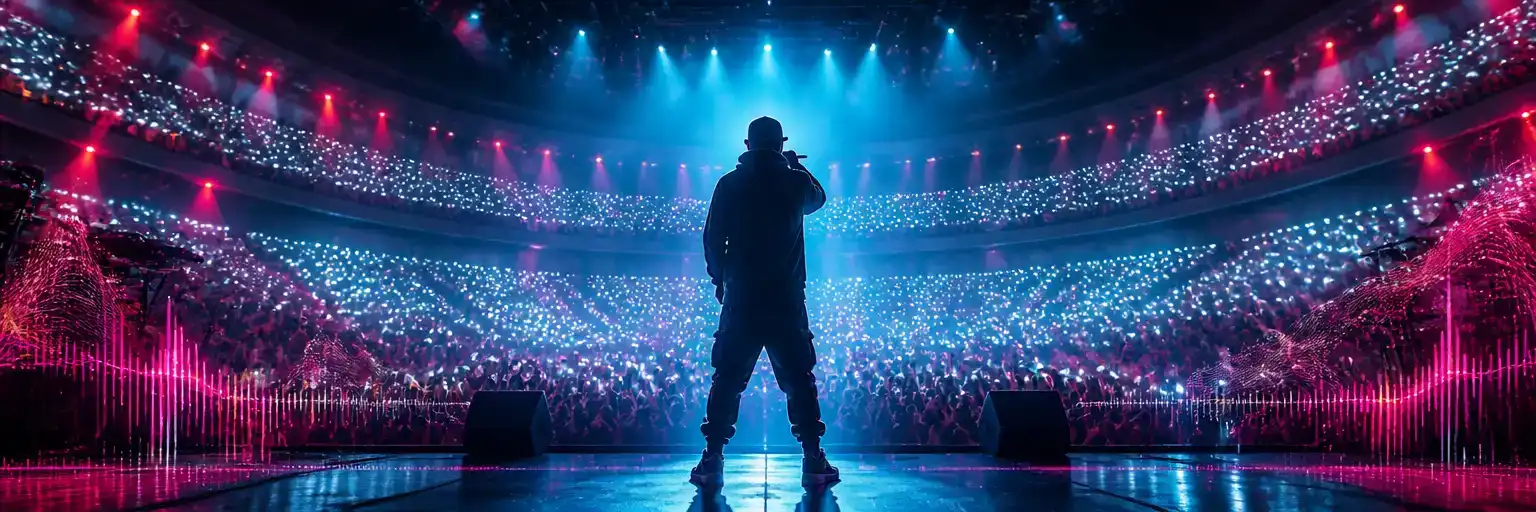
Springsteen is right: rock and hip hop have always been political
Springsteen's question about rock and hip hop guts genre gatekeeping, and it reminds us that political music only counts when it risks something.
AI-generated image
Who gets to say what counts as protest music? For decades the answer came with a guitar attached, and Bruce Springsteen has just helped dismantle that assumption with one rhetorical question: what, exactly, is rock 'n' roll or hip hop?
The line comes from "Home of the Brave Backstage," a limited-run video series that, as SPIN describes it, features musicians discussing the Trump administration, political activism and the role artists can play in pushing back against authoritarianism. Springsteen is the first guest. In the excerpt circulating, he says music and politics have "always been intertwined, because what is rock 'n' roll or hip-hop?"
The question does more work than the answer
We think the most interesting part is not the politics but the pairing. Putting rock and hip hop in the same sentence, as siblings and not rivals, quietly rejects the old turf war in which one is "real music" and the other is "a trend." When a rock institution of his stature asks what either genre is if not entangled with politics, the argument that rock owns authenticity gets much harder to make with a straight face.
He also does something less predictable. As AI-Chords reports, he describes himself as "a defender of democracy, of American values," yet does not believe every artist must be political. Elvis Presley, James Brown and Curtis Mayfield, he says, "changed the world just as much as Woody Guthrie" through their cultural presence alone.
That choice of examples matters. Presley, Brown and Mayfield are not pamphleteers. In our reading, their influence came from how they sounded, moved and carried themselves. That is a generous, and in our view correct, take on political music: sometimes the radical thing is simply who is allowed to take up space on the stage.
Comfort is the real enemy
Here is where we push beyond what Springsteen said. A protest song that offends nobody in the room is not protest, it is décor. Political music matters when it costs something: a booking, an audience, a friendly relationship with power. Springsteen's long public clash with Trump, which Far Out notes first sparked in 2016 after he opposed Trump's use of "Born in the USA," is at least a case of an artist accepting that friction.
The risk cuts in every direction, though, and this is where the debate gets uncomfortable for everyone. Take the New Zealand Jewish Council's complaint, published on Scoop, that Twisted Frequency Festival withdrew an invitation to Israeli musician Dekel, reportedly over his nationality, his previous performances in Israel and his lack of a public statement on Gaza. We are only hearing one side here, and we have not seen the festival's reasoning. But the principle at stake is worth chewing on: the council argues that freedom of expression includes the freedom not to make political statements at all.
We find that a useful counterweight to the way Springsteen frames things. Playback describes him recalling the anti-war concerts of his youth and describing rock as an expression of freedom. If music is about freedom, then compelled declarations are a strange way to honor it. Political music has force because artists choose to speak, and a loyalty test imposed from outside turns that choice into an obligation.
Our verdict
Springsteen is right, and his two points fit together. Genre snobbery is a form of gatekeeping that deserves to die, and political commitment is only worth something when it is chosen and when it carries a price. Anyone who wants "uncomfortable" music again should start by listening outside their usual genre, and by resisting the urge to demand that every artist perform their politics on cue.
If you want a practical takeaway, it is this: judge political music by what it risks, not by the instrument it uses. By that standard, a guitar band and a rapper can be in exactly the same fight. Springsteen just pointed at it.
No topics yet: start the first one.
More stories
Bono's "goodbye" isn't U2's farewell; the real bet is human chemistry
Fans are parsing one pause in a Zane Lowe interview for a retirement notice, but the bolder story is U2 wagering a new album on imperfect humans over machines.
My Chemical Romance's slow comeback is smart, but only if the songs show up
Gerard Way's plan for a 2027 studio year and a 2028 return to the road is the opposite of a nostalgia cash-in, and that makes the album the real test.

RAYE's Lizard Music job is a bet on authorship, not a side hustle
Scoring and voicing a character in Benny Safdie's Dwayne Johnson film can give RAYE authorship and longevity beyond the single, but only if she writes real music.

Orelsan picks a fight with CNews, and he's right to
By naming the far right and CNews in a song debuted in Bordeaux, Orelsan trades some audience for credibility. In today's France, that is the kind of risk rap exists to take.